

ATLAS Upgrade
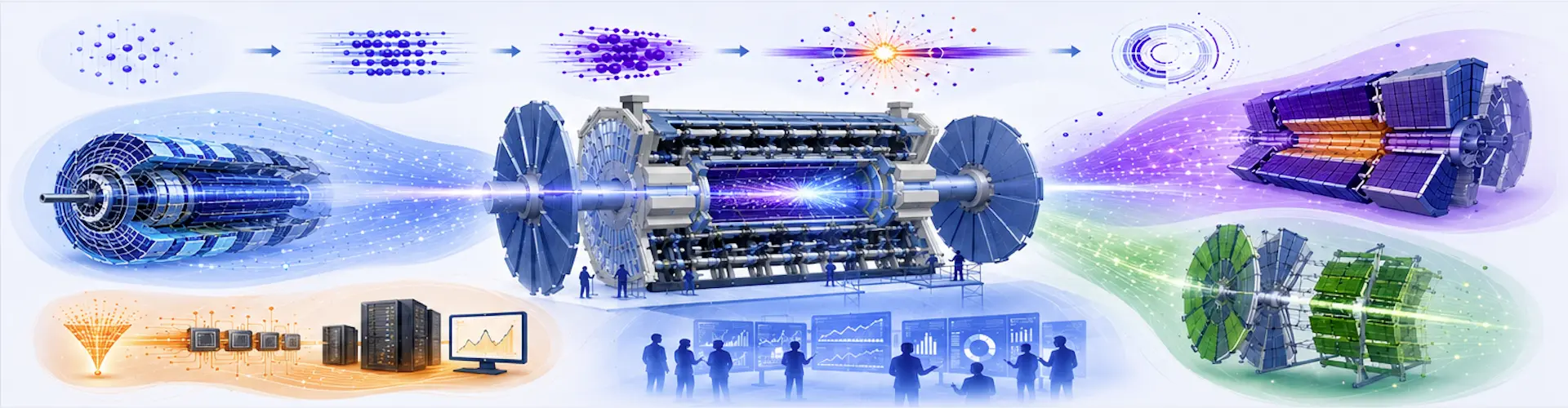
We are strongly involved in the ATLAS upgrade program for the High Luminosity LHC, contributing to detector design, electronics development, and integration of new tracking and calorimeter systems.
ATLAS UPGRADE FOR HL-LHC
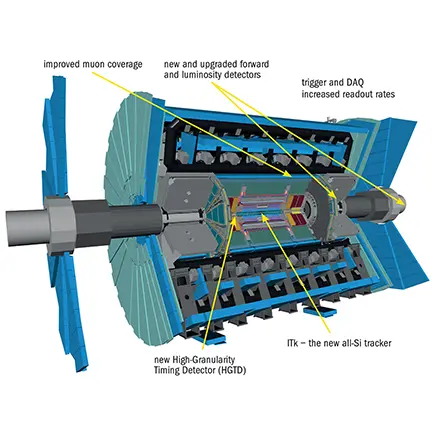
The ATLAS detector is undergoing a major upgrade in preparation for the High Luminosity Large Hadron Collider, which will substantially increase both the collision rate and the integrated luminosity delivered to the experiments. This upgrade is essential to operate under the extreme conditions expected at the HL LHC, including significantly higher radiation levels, increased event pile up, and more complex detector occupancies.
One of the most significant modifications is the complete replacement of the current Inner Detector with a new all silicon Inner Tracker, designed to provide higher granularity, improved radiation tolerance, and enhanced tracking performance over an extended pseudorapidity range.
In addition, substantial upgrades are being implemented in the calorimeter and muon systems, as well as in the trigger and data acquisition infrastructure, incorporating modern electronics and more advanced real time selection algorithms. These improvements will ensure that ATLAS maintains excellent performance while extending its physics potential, enabling more precise measurements of the Higgs boson and top quark and increasing sensitivity to new particles and phenomena beyond the Standard Model.
TILE CALORIMETER
The upgrade of the Large Hadron Collider to the High Luminosity phase, scheduled to begin in 2027, represents a major step forward in accelerator performance and detector capabilities. Within this project, the TileCal IFIC group is responsible for the design, production, installation, and maintenance of the PreProcessor modules for the Tile Calorimeter detector.
These modules provide the interface to the on detector electronics and are responsible for reading and processing the data, as well as configuring, controlling, and monitoring the internal electronics of the detector. The TileCal PreProcessor system consists of 32 modules equipped with state of the art fiber optic links and high performance FPGAs, delivering a total bandwidth of approximately 40 Tbps. The system is based on the ATCA telecommunications standard, which enables robust interconnection between modules and integration into communication networks. In addition, each PreProcessor module incorporates an ARM processor dedicated to control, configuration, and system management tasks.

ATLAS TRACKER
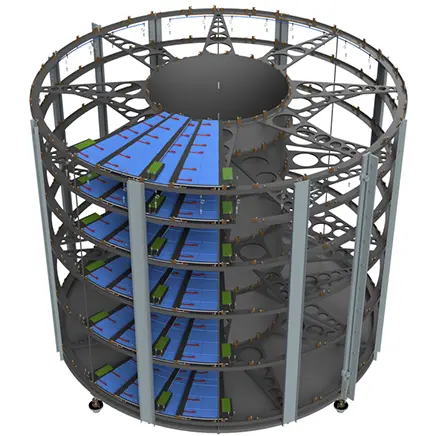
The ATLAS group at IFIC Valencia is strongly involved in the upgrade of the central tracking system for operation at the High Luminosity LHC. The new Inner Tracker will replace the current detector with an all silicon system composed of an inner pixel detector and a large area silicon strip tracker covering about 165 m². The strip detector consists of a central barrel with four cylindrical layers, each 2.8 m long, and two endcaps with six disks per side to ensure full coverage.
The basic mechanical elements are the staves in the barrel and the petals in the endcaps, lightweight structures that provide mechanical support, precise alignment, and integrated electrical, optical, and cooling services. The barrel comprises 392 staves, while each endcap disk hosts 32 petals.
Our group contributes to sensor R&D within the RD50 collaboration, readout electronics development for the endcaps, and the design and validation of local and global support structures, including finite element analysis and service integration.