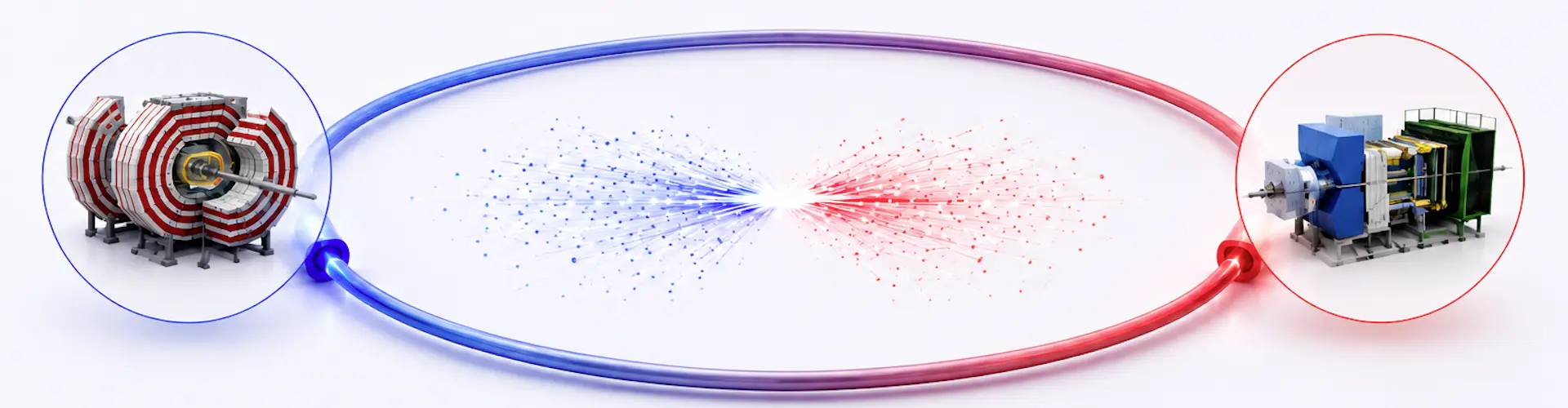
We participate in complementary LHC experiments such as MATHUSLA and MoEDAL, extending the sensitivity to long lived particles and other signatures of new physics.
MATHUSLA
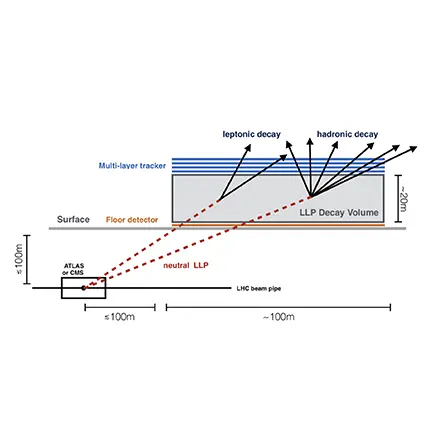
MATHUSLA, the Massive Timing Hodoscope for Ultra Stable Particles, is a proposed experiment at CERN designed to search for long lived particles at the Large Hadron Collider. Such particles, predicted in many scenarios beyond the Standard Model, can travel significant distances before decaying and are therefore challenging to detect with the main LHC detectors.
Located on the surface above the ATLAS or CMS interaction points, MATHUSLA would detect particles that escape the primary detectors and decay outside their sensitive volumes. The experiment consists of a large area detector equipped with precise tracking and timing systems. By combining spatial reconstruction with accurate timing measurements, it can identify displaced decays of slow moving, long lived particles.
This approach significantly enhances sensitivity to new physics signatures, including dark matter candidates and other exotic states, complementing the discovery potential of the main LHC experiments.
MOEDAL
MoEDAL, the Monopole and Exotics Detector at the LHC, is designed to search for manifestations of new physics through highly ionising particles in a manner complementary to the ATLAS and CMS experiments. Its primary objective is the search for magnetic monopoles, as well as massive, stable or metastable, slow moving particles carrying single or multiple electric charge, as predicted in various scenarios beyond the Standard Model.
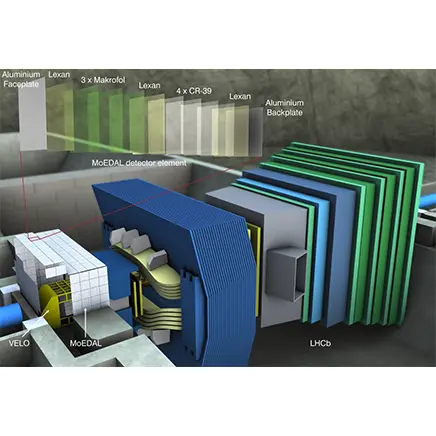
The MoEDAL detector is installed around the interaction region in the LHCb VELO cavern. It is a unique and largely passive LHC experiment, combining nuclear track detectors with dedicated monopole trapping volumes capable of capturing highly ionising particles.
Two additional subdetectors, MAPP and MALL, further extend the physics reach of MoEDAL. MAPP, currently being prototyped at Point 8 of the LHC, is designed to search for neutral long lived particles that decay visibly and for milli charged particles producing anomalously low ionisation signals. MALL is sensitive to the decays of trapped, charged, massive, and extremely long lived particles by monitoring the trapping volumes.
Carrer del Catedrátic José Beltrán Martinez, 2
46980 Paterna, Valencia