

ATLAS Performance and Operations
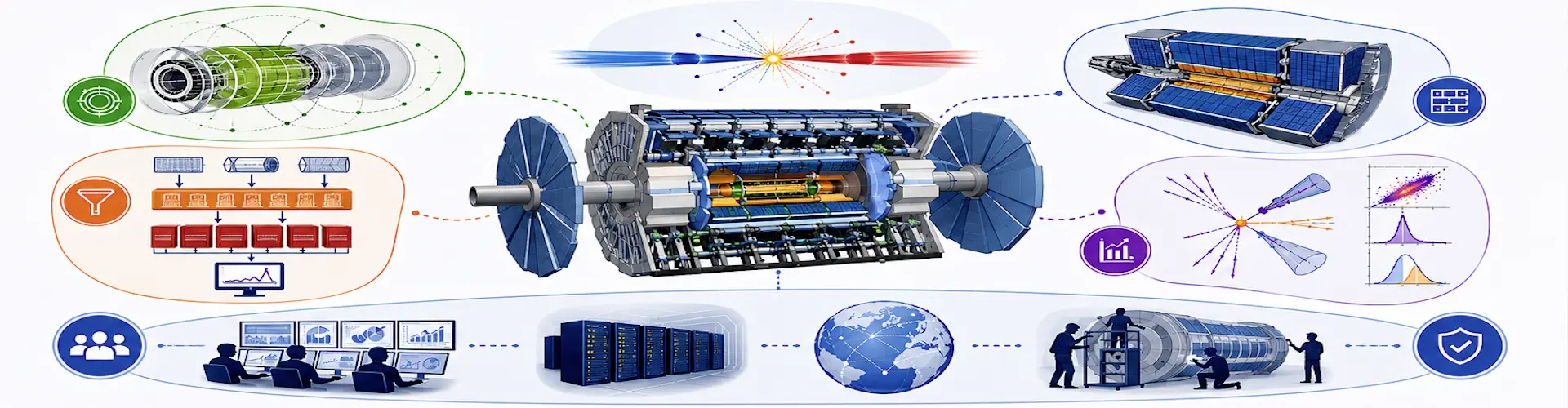
We contribute to the construction, operation, calibration, and performance of key ATLAS detector systems, including tracking, calorimetry, trigger, and object reconstruction.
IFIC CONTRIBUTION TO ATLAS CONSTRUCTION
ATLAS is one of the major experiments at the Large Hadron Collider, designed to investigate the fundamental constituents of matter and the forces governing their interactions. IFIC has played a significant role in the construction and operation of key components of this complex detector.
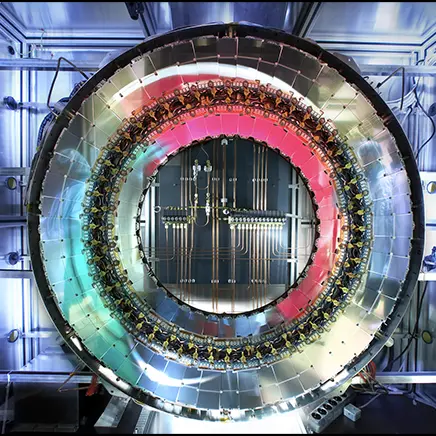
Within the Inner Detector, our contribution focused on the Semiconductor Tracker, where we assembled and characterized 281 silicon microstrip modules, corresponding to 14 percent of the SCT end caps, and produced both Outer Thermal Enclosures. We also participated in the macro assembly and installation of the Inner Detector in the ATLAS cavern.
For the Tile Calorimeter, a hadronic calorimeter composed of iron absorbers and scintillating tiles, IFIC assembled the submodules of a full barrel section. We qualified 3,000 photomultiplier tubes and led the design, production, installation, and maintenance of the Read Out Drivers, as well as the implementation of the TileCal data acquisition software.
In addition, IFIC has been strongly involved in the ATLAS trigger system and has coordinated this critical activity since 2020.
INNER DETECTOR
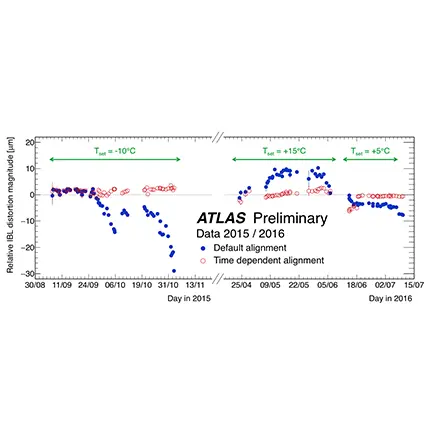
The physics performance of the ATLAS experiment critically depends on the precise alignment of its Inner Detector tracking sensors, which is essential for accurate track reconstruction in nearly all analyses. The Inner Detector comprises more than 36,000 silicon modules and approximately 350,000 drift tubes distributed across three subdetectors: silicon pixel detectors, silicon strip detectors, and gas drift tubes. Determining the alignment requires solving for nearly 750,000 degrees of freedom, representing a major computational challenge.
A hierarchical alignment strategy is employed, beginning with large detector structures and progressively refining the alignment down to smaller components. The procedure is integrated into the ATLAS calibration loop, delivering updated alignment constants within 24 hours of data taking, with additional corrections applied approximately every 20 minutes to account for short term movements. The quality of the alignment constants is continuously monitored. Long term systematic uncertainties are evaluated using reconstructed resonances such as Z → μμ, J/ψ → μμ, and K⁰_s → ππ. Complementary validations include the E over p method for electrons from W and Z decays and impact parameter studies based on Z boson events.
TILE CALORIMETER
Our group plays a central role in the operation and maintenance of the Tile Calorimeter back end electronics. We are responsible for ensuring the performance and reliability of the 32 Read Out Driver boards installed in the ATLAS electronics cavern, which have been operating successfully since 2008. Our team implemented the signal reconstruction algorithms used within the ROD system to process LHC collision data in real time, contributing to the precise measurement of energy deposits in the calorimeter. These algorithms are essential for the performance of the ATLAS trigger and data acquisition system, particularly under high luminosity conditions where pile up is significant.
In addition to hardware support, we are actively involved in the analysis of TileCal data, including studies of detector timing, energy calibration using isolated hadrons, and the performance of missing transverse energy reconstruction. Our group remains one of the most experienced teams in ATLAS in data acquisition software and calorimeter signal processing.
TRIGGER/DAQ
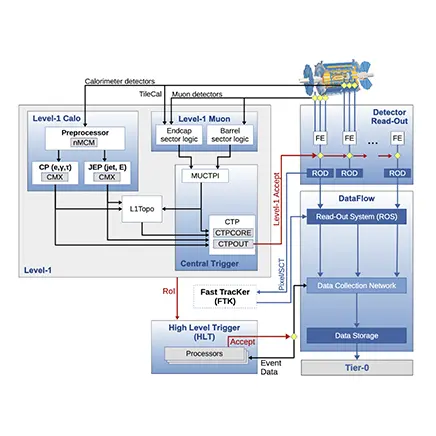
The trigger system is a crucial component of the ATLAS experiment, as it is responsible for the real time selection of proton–proton collision events produced at the LHC. It reduces the event rate by four orders of magnitude, from 40 MHz to approximately 1 kHz, enabling permanent storage and subsequent physics analysis.
ATLAS employs a two level trigger system consisting of a hardware based Level 1 trigger and a software based High Level Trigger. The Level 1 trigger uses coarse granularity information from the calorimeter and muon detectors to make an initial rapid decision. The High Level Trigger has access to full detector granularity and complete event information, allowing the execution of sophisticated algorithms similar to those used in offline reconstruction to further refine the event selection.
For Run 3, the ATLAS trigger system underwent a major upgrade, including new hardware components and a redesigned software framework, aimed at increasing signal acceptance and improving sensitivity to previously unexplored regions of phase space. IFIC Valencia has made major contributions to this effort and has coordinated the trigger area since October 2020.
COMBINED PERFORMANCE
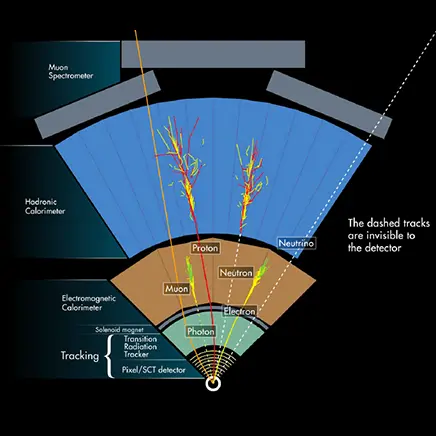
The ATLAS Valencia group is strongly involved in studies of electron, photon, and tau performance. These particles are reconstructed using both tracking information from the Inner Detector and energy deposits in the calorimeters. High performance in the reconstruction and identification of electrons, photons, and taus is essential for precision measurements of Higgs boson properties, numerous Standard Model processes, and searches for new phenomena.
Tau leptons decay either leptonically (about 35 percent) or hadronically (about 65 percent). Hadronically decaying taus are distinguished from jets or electrons using advanced machine learning techniques. The ATLAS Valencia group contributes to measurements of tau properties, including decay mode classification, energy calibration, and identification efficiency, and is actively involved in the development and maintenance of the tau reconstruction software.
We also participate in measurements of the reconstruction and identification efficiency of isolated electrons using data from well known Z boson decays to electron pairs. In addition, we play an important role in understanding and reducing backgrounds where other particles, such as pions, are misidentified as electrons.