

ATLAS Physics Analysis
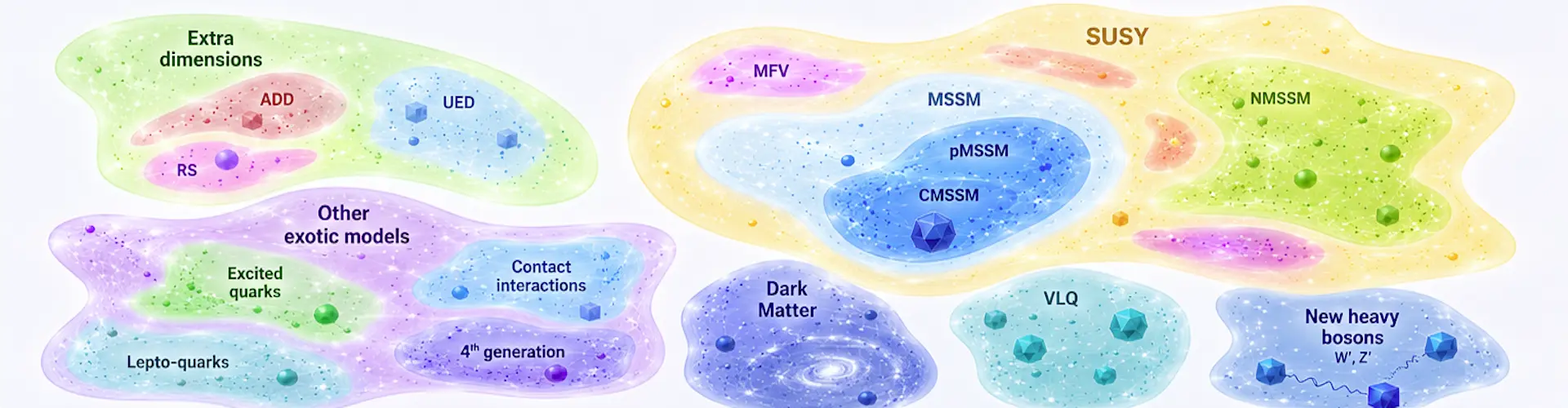
The search for physics beyond the Standard Model (BSM) represents one of the most compelling frontiers in particle physics. Although the Standard Model has been remarkably successful in describing a wide range of phenomena, it leaves several fundamental questions unanswered. These include the nature of dark matter, the origin of the matter–antimatter asymmetry in the Universe, and the possible existence of additional particles or interactions. To address these open issues, scientists in the ATLAS experiment at CERN pursue an extensive research program aimed at uncovering phenomena that could extend our current theoretical framework.
Within ATLAS, researchers investigate a broad spectrum of BSM scenarios. A major objective is the search for dark matter, which constitutes approximately 27 percent of the energy density of the Universe but has not yet been directly observed. ATLAS searches for dark matter signatures by studying events with significant missing transverse momentum, which may indicate invisible particles escaping detection. Additional efforts include searches for extra spatial dimensions, new heavy resonances, and previously unknown forces.
ATLAS also studies rare or non standard particle decays that deviate from Standard Model predictions. Such processes could provide indirect evidence of new physics through precision measurements and detailed comparisons with theoretical expectations.
The IFIC group plays a significant role in these BSM studies. We focus on dark matter searches in top quark production processes, looking for deviations that could signal new interactions. We also investigate long lived particles and other dark matter candidates, developing dedicated techniques to identify their distinctive displaced or unconventional decay signatures in high energy collisions. In addition, we explore extended Higgs sector scenarios, including searches for additional heavy neutral Higgs bosons, particularly in regions where models such as the Minimal Supersymmetric Standard Model predict enhanced decays into tau leptons.
IFIC has contributed to studies of supersymmetric models and their possible connections to neutrino mass generation. Advanced machine learning methods are employed to improve event classification, optimize signal extraction, and develop innovative search strategies. Machine learning techniques are also used to accelerate event simulation, enabling more efficient data analysis, particularly in searches for ttbar resonances. Together, these efforts contribute to advancing our understanding of physics beyond the Standard Model.
DARK MATTER
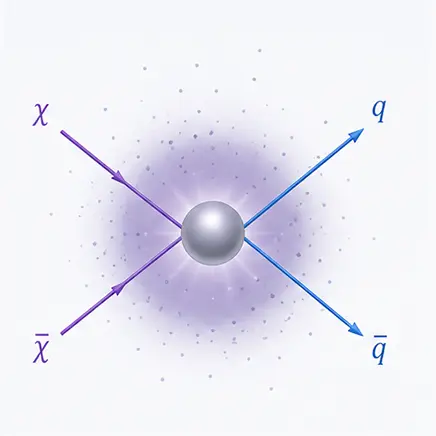
Our group participates in dark matter searches using complementary strategies. We investigate potential signals of dark matter in top quark production processes, searching for deviations from Standard Model predictions that could indicate new interactions. In particular, we analyze events in which top quarks are produced in association with significant missing transverse energy, a possible signature of dark matter particles escaping detection. These studies provide important constraints on models describing dark matter couplings to Standard Model particles.
In addition, we explore scenarios involving long lived particles as dark matter candidates. Such particles may travel measurable distances before decaying or appear stable within the detector, producing distinctive experimental signatures. We develop dedicated techniques to identify their unconventional decay patterns in high energy collisions. Together, these approaches aim to improve our sensitivity to dark matter and to clarify its possible connections to physics beyond the Standard Model.
LONG-LIVED PARTICLES
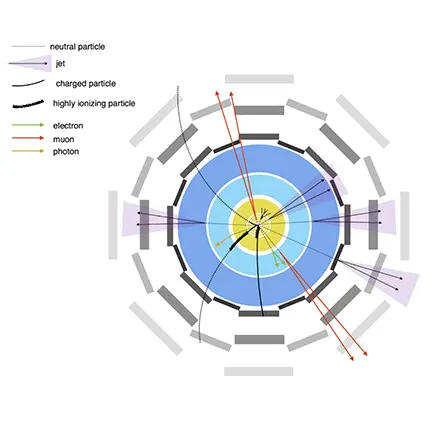
Many theories beyond the Standard Model predict new particles that can travel a measurable distance before decaying into Standard Model objects. When such decays occur within the ATLAS detector, they produce highly unconventional signatures for which standard searches are often inefficient. This means that, unless Long Lived Particles are explicitly targeted in dedicated analyses, potential discoveries could be overlooked.
A wide range of dedicated searches has therefore been developed within ATLAS to address these unique experimental signatures. These efforts include specialized reconstruction algorithms, where machine learning techniques significantly enhance efficiency, dedicated trigger strategies to select interesting events in real time, and tailored methods to suppress non standard background sources that must be carefully considered. In general, each unconventional signature requires a dedicated analysis strategy.
At IFIC, we focus on searches for displaced jets arising from the decay of long lived particles in the calorimeters.
HIGGS
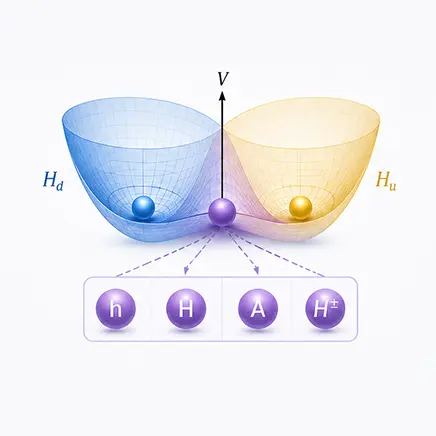
Although a Higgs boson consistent with the Standard Model prediction has been discovered, it remains possible that it is part of a more complex Higgs sector. Several theories beyond the Standard Model extend the scalar sector by introducing a second Higgs doublet, as in Two Higgs Doublet Models, leading to the existence of multiple Higgs bosons. The Minimal Supersymmetric Standard Model is one such example and predicts five physical Higgs bosons.
The ATLAS group at IFIC searches for additional heavy neutral Higgs bosons decaying into tau lepton pairs, with particular emphasis on the channel in which both tau leptons decay hadronically. This final state is especially relevant in MSSM scenarios where the ratio of the vacuum expectation values of the two Higgs doublets, denoted tanβ, is large. In this regime, the couplings of the Higgs bosons to down type fermions are enhanced, increasing the branching fraction into tau leptons. Consequently, the tau tau channel provides the highest sensitivity across large regions of the model parameter space.
SUSY
The majority of observations in particle physics are well described by the Standard Model. However, open questions such as the nature of dark matter and the possibility of grand unification point to the existence of new physics. Supersymmetry (SUSY) provides a compelling framework that addresses several of these issues by postulating a symmetry between bosons and fermions, thereby predicting a new spectrum of particles that can be probed in high energy proton–proton collisions with the ATLAS experiment.
IFIC has pioneered searches for SUSY without R parity, particularly in models that explain neutrino masses through bilinear R parity violating terms. Scenarios conserving R parity have also been investigated, including those featuring final states with a Z boson. In recent years, we have focused on models motivated by naturalness considerations. These analyses target events with leptons, jets, and significant missing transverse momentum. The group has also contributed to searches involving long lived particles, which remain among the least explored and most experimentally intriguing signatures.

RESONANCES T-TBAR
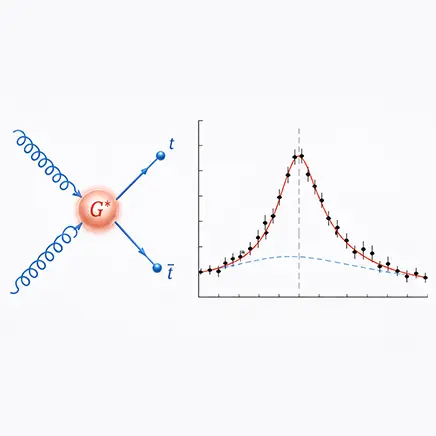
The objective is to search for ttbar resonances by improving the resolution of the reconstructed invariant mass using machine learning and deep learning techniques. Better resolution can be achieved through the correct identification and reconstruction of the resonance decay products, which is the central goal of our ML based study. A detailed comparison between the ML approach and the traditional chi squared method has been performed, and the initial results demonstrate clear improvements in performance.
Simulated data are essential for ATLAS physics analyses, which require large statistics for both signal and background samples. However, full simulation is computationally demanding and time consuming. To address this, we explore ML based generative models to accelerate event generation and detector simulation. Techniques such as Variational Autoencoders, Generative Adversarial Networks, and Normalizing Flows show promising results, including in the estimation of systematic uncertainties. First studies using these ML generated events have been carried out for ttbar resonance searches and other physics applications.