


ATLAS Physics Analysis
The Higgs boson is a fundamental particle in the Standard Model of particle physics, responsible for the mechanism that gives mass to elementary particles. It arises as a quantum excitation of the Higgs field, a scalar field that permeates all space. In the Standard Model, the Higgs boson is a massive, electrically neutral scalar particle with spin zero and even parity. It interacts with other particles proportionally to their masses, meaning that heavier particles couple more strongly to the Higgs field.
The Higgs field itself consists of two neutral and two charged components, forming a complex doublet under the SU(2) weak isospin symmetry. Its characteristic “Mexican hat” potential causes the field to acquire a nonzero vacuum expectation value, thereby spontaneously breaking electroweak symmetry. This process, known as the Higgs mechanism, allows certain particles, such as the W and Z bosons, to acquire mass, while others, including the photon, remain massless.
The theoretical foundation for this mechanism was established in 1964 by several physicists, including Peter Higgs and François Englert. Their work predicted not only the existence of the field but also a new particle, the Higgs boson, which would serve as experimental confirmation of the mass generating mechanism. For decades, detecting this particle remained one of the central challenges in particle physics.
In 2012, after nearly fifty years of experimental effort, the ATLAS and CMS experiments at CERN’s Large Hadron Collider announced the discovery of a new boson with properties consistent with those predicted for the Higgs boson. This landmark discovery completed the particle content of the Standard Model and confirmed a crucial element of our understanding of fundamental interactions. Higgs and Englert were awarded the Nobel Prize in Physics in 2013 for their theoretical contributions.
At IFIC, we actively study the properties of the Higgs boson through detailed analyses of its interactions with other particles, such as the top quark and the tau lepton. We also investigate rare decay modes and search for potential deviations from Standard Model predictions that could signal the presence of new physics. Our work includes high precision measurements, advanced machine learning techniques for signal extraction, and dedicated searches for phenomena such as Higgs self coupling and lepton flavour violating decays, all aimed at exploring what may lie beyond the Standard Model.
SM HIGGS
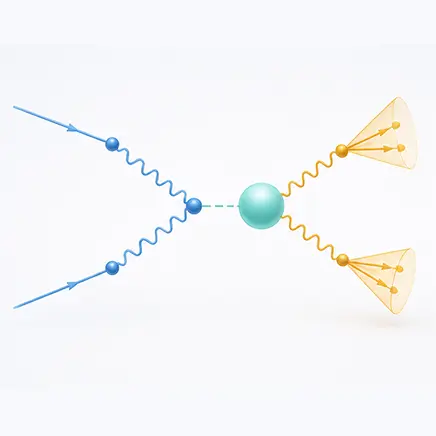
The Yukawa couplings of the Higgs boson to fermions, particularly the tau lepton and the top quark, are key to testing the Standard Model and understanding fermion mass generation. The tau, as the heaviest lepton, provides direct access to the Higawa interaction, although its short lifetime makes it experimentally challenging. We measure the tau Yukawa coupling using Run 2 data.
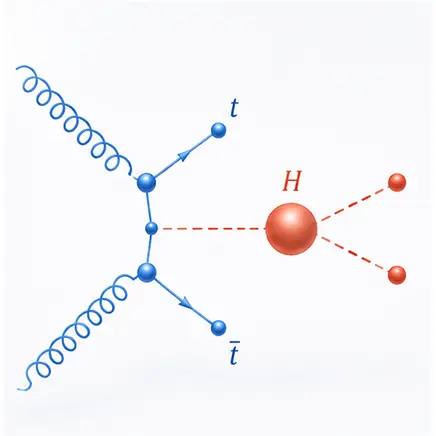
The top quark, the heaviest known elementary particle, has the largest Yukawa coupling and is studied through associated production processes such as ttH and tH. These analyses employ advanced machine learning techniques to separate rare signal events from large backgrounds.
We also probe Charge–Parity symmetry in top–Higgs interactions, which may shed light on the matter–antimatter asymmetry of the Universe. In addition, we search for lepton flavour violating Higgs decays, including H→eτ and H→μτ, and set upper limits on their branching ratios at 95 percent confidence level.
DIHIGGS
Despite the significant progress made in measuring the Higgs boson couplings, it has not yet been experimentally established that the Higgs boson couples to itself, known as the self coupling. One of the primary manifestations of this property is the production of Higgs boson pairs (HH).
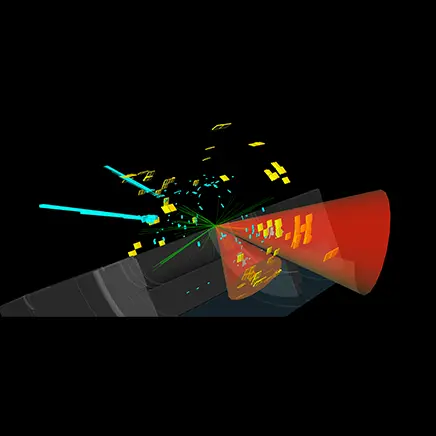
The ATLAS IFIC group participates in several HH analyses, including the channel where the Higgs boson pair decays into two bottom quarks and two photons (HH → bbγγ). This channel offers a favorable balance between branching ratio and experimental sensitivity.
With improved analysis strategies and advanced machine learning techniques, the sensitivity to Higgs boson pair production is expected to increase significantly. The data to be collected at the Large Hadron Collider in the coming years will enhance the potential to observe Higgs self coupling and determine whether its value is consistent with the prediction of the Standard Model.
TOP/HIGGS INTERPLAY
Our work focuses on the interplay between the top quark and the Higgs boson, which is crucial for understanding both the Standard Model and possible extensions beyond it. We study processes such as top–Higgs associated production (ttH and tH), where the Higgs boson is produced in association with top quarks, allowing precise measurements of the top quark Yukawa coupling. These interactions provide stringent tests of the Standard Model and offer sensitivity to potential deviations that could signal new physics.
Our analyses include detailed studies of multiple top quark and Higgs boson decay channels, employing advanced machine learning techniques to enhance the separation of signal events from background processes. In addition, we investigate Charge–Parity (CP) symmetry in top–Higgs interactions, exploring whether CP violation in this sector could contribute to explaining the matter–antimatter asymmetry of the Universe.
This program is essential for improving our understanding of top quark and Higgs boson dynamics and their implications for future discoveries in particle physics.