


ATLAS Physics Analysis
The top quark is the most massive of all known elementary particles, with a mass of approximately 172.76 GeV/c². It was discovered in 1995 by the CDF and DØ experiments at Fermilab, completing the third generation of quarks predicted by the Standard Model. Like all quarks, it is a spin 1/2 fermion and participates in all four fundamental interactions: gravitational, electromagnetic, weak, and strong. Owing to its exceptionally large mass, the top quark has the strongest Yukawa coupling to the Higgs boson, making it a central player in electroweak symmetry breaking and mass generation within the Standard Model.
Top quarks are predominantly produced in proton–proton collisions at the LHC via the strong interaction, mainly as top–antitop (tt̄) pairs. Single top production through electroweak processes also occurs. Once produced, top quarks decay almost exclusively into a W boson and a bottom quark via the weak interaction. The top quark lifetime is extremely short, about 5 × 10⁻²⁵ seconds, shorter than the hadronization timescale. As a result, it does not form bound states (hadrons), offering a rare opportunity to study a “bare” quark, largely unaffected by confinement effects.
At IFIC, our research group plays a leading role in high precision studies of top quark production and decay at the LHC. We focus on observables sensitive to new physics, including CP violation in the Wtb vertex, top quark polarisation, and differential angular decay distributions. We were the first to measure all six W boson polarisation observables and to achieve the most precise determination of top polarisation. We also investigate processes such as tt̄Z, tt̄W, and tt̄γ to probe the top quark electroweak couplings and test predictions of the Standard Model Effective Field Theory. In addition, we study boosted top quarks, produced at high energies where their decay products are highly collimated, using advanced jet substructure techniques. Our team contributes to global EFT fits that combine diverse measurements to constrain new physics scenarios. Through these efforts, we aim to deepen our understanding of the top quark and exploit it as a sensitive probe of physics beyond the Standard Model.
TOP PROPERTIES
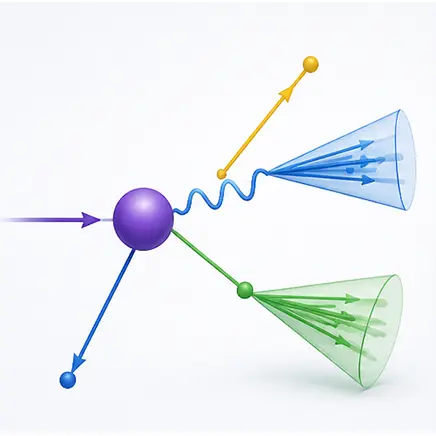
The IFIC group has led high precision studies of single top quark production in the t channel, a process highly sensitive to CP violation in the Wtb vertex. We achieved the first measurement of all six W boson polarisation observables and obtained the most precise determination of top quark polarisation to date. We also performed the first double and triple differential angular decay measurements in single top events.
Using Run 2 LHC data, we measured for the first time the three components of the top quark polarisation vector, separately for top and anti top quarks. In addition, we provided differential cross section measurements at the stable particle level to constrain the Wtb dipole operator within an effective field theory framework.
In collaboration with the University of Pittsburgh, we proposed a novel method to measure the fully four dimensional top quark decay distribution, enabling significantly improved constraints on the structure of the Wtb vertex.
TOP PAIR + BOSONS
Our research focuses on precision measurements of top quark properties, which are essential for testing the Standard Model and exploring possible new physics scenarios. We study processes such as top quark pair production in association with Z or W bosons (tt̄Z, tt̄W) and with photons (tt̄γ), which directly probe the electroweak couplings of the top quark. The tt̄Z and tt̄W channels are particularly sensitive to modifications of the weak interaction and allow us to constrain anomalous couplings within the Standard Model Effective Field Theory framework.
The tt̄γ process provides access to the electromagnetic dipole moments of the top quark and is sensitive to spin correlations and charge asymmetries. We have carried out inclusive and differential cross section measurements in multiple final states, employing advanced analysis strategies including neural network classifiers to enhance signal sensitivity.
These studies provide stringent tests of the Standard Model at high precision and place competitive constraints on scenarios of physics beyond it.
TOP MASS
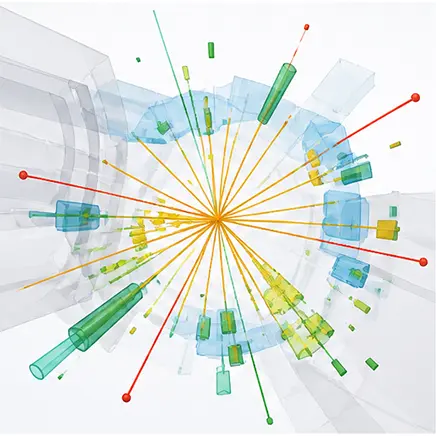
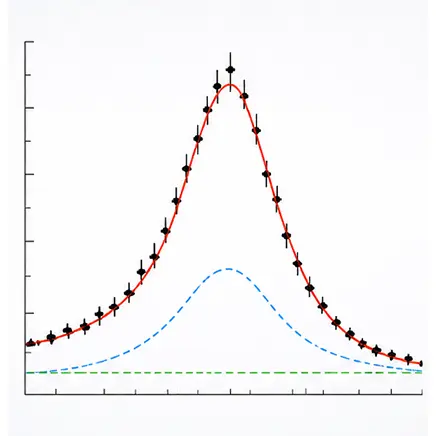
We perform precision measurements of the top quark mass, a key parameter of the Standard Model, using multiple decay channels and complementary analysis techniques. Top–antitop events are studied in the lepton+jets and dilepton final states, where the mass is reconstructed from the kinematic properties of the decay products.
To control systematic uncertainties, we apply advanced methods such as template fits, matrix element techniques, and ideogram-based analyses. Alternative strategies, including invariant mass observables and kinematic endpoints, provide additional sensitivity and cross-checks. We also evaluate the impact of major uncertainties, notably the jet energy scale, b-tagging, and theoretical modeling.
By combining results across channels and approaches, we achieve high precision and ensure consistency. These measurements contribute to global combinations and provide essential input to precision electroweak fits, strengthening tests of the Standard Model.
BOOSTED TOPS AND JET SUBSTRUCTURE
At the Large Hadron Collider, we study boosted top quark production with the ATLAS experiment to probe high-energy regimes where the top quark decay products are highly collimated. In this regime, the b-jet and hadronic W decay products often merge into a single large-radius jet, reducing the effectiveness of traditional reconstruction methods.
To address this, we use advanced jet substructure techniques, including grooming algorithms such as trimming and pruning, and tagging methods based on jet mass, N-subjettiness, and energy correlation functions. These tools enable efficient identification of hadronically decaying boosted top quarks, even in high pile-up conditions.
We measure boosted top production cross sections and kinematic distributions and compare them with theoretical predictions to test QCD at high energies. These studies also enhance sensitivity to heavy resonances decaying into top quark pairs, providing potential insight into physics beyond the Standard Model.

EFT INTERPRETATIONS
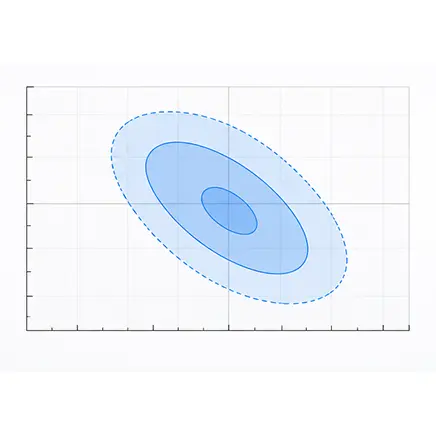
We play a key role in interpreting top quark measurements within the Effective Field Theory framework. Precision observables such as top pair production in association with gauge bosons, differential cross sections, and polarization measurements are used to constrain higher dimensional operators in the Standard Model Effective Field Theory.
We contribute to global fits that combine multiple measurements, enhancing sensitivity to new physics while preserving model independence. Our work includes theoretical calculations, the development of simulation tools, and the design of analysis strategies that ensure robust and systematically controlled interpretations.
By translating Large Hadron Collider measurements into quantitative constraints on possible extensions of the Standard Model, we help advance precision top quark physics and guide future experimental and theoretical efforts.